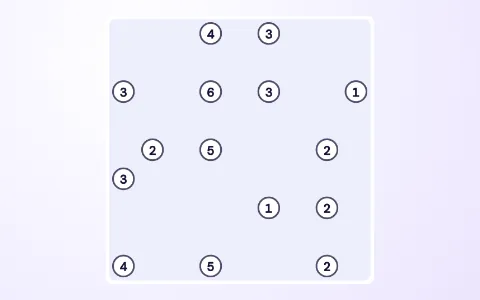
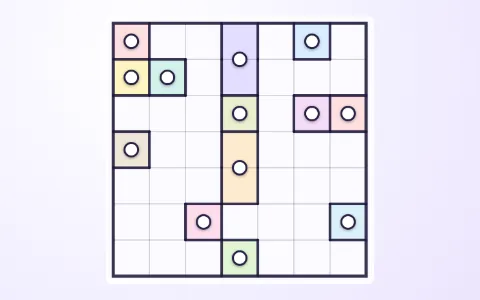
How to play Circuit Paths
Divide every dot into separate paths; each path follows the rules for length, endpoints and anything else the puzzle sets. Also known as Path partition.
The rules
- Every playable dot belongs to exactly one path. No dot is shared and none is left over (unless the puzzle says some may be).
- Paths move along allowed connections — across and down on a grid, six ways on a hexagonal board, along the links on a freeform board.
- A path starts and ends on endpoint dots and never passes through one. Internal dots join exactly two neighbours; endpoints join one.
- Each type adds rules: a fixed length (Classic: six dots), matching colours, endpoint numbers that give the length, target sums, rising numbers, exact turns, regions to visit, words to spell, or closed loops. Bridges and tunnels let two paths cross.
- More types: triangle boards; two floors joined by lettered lifts; branching networks (only ✚ junctions branch, and in Network Junctions a network may also close a loop); Match Up (join each question to its answer); Double Lengths (one path is twice as long as another); One-Way Streets (all the arrows on a path point the same way); Hidden Ends (any dot may end a path, but grey stop dots can only be ends); Odd Dot Out (exactly one dot can’t be used); and Cheapest Routes (any valid answer, but aim for the lowest cost).
Playing Circuit Paths on Puzzle Solvers
- Choose a puzzle type and size, then press New Puzzle. The rules for that type are written under the board.
- Drag from dot to dot to draw a path. Drag back along it to rub out. Tap a path to select it and press Delete, or double-tap / right-click a dot to clear its path.
- Every dot must end up on exactly one path, and every path must follow the rules — the right length, the right endpoints, and any sums, words, turns or regions.
- Mistakes get a specific message (“This path contains seven dots; it must contain six.”). Hint and the Genie explain the next forced step. 📽 Present makes the board big for a classroom screen.
- Choose Board shape: Symmetric for boards with a symmetric outline. In networks, only the ✚ junction squares may branch; in cost challenges any valid answer solves it, and the aim is the cheapest.
Using the Circuit Paths solver
- Pick the board type and size. Use the tools to place endpoints, dots, holes, bridges, tunnels, colours, numbers, letters, regions, checkpoints and portals (freeform boards: add dots and links).
- Set the rules in the panel: paths or loops, length, endpoint pairing, movement, turns, sums, regions, words and cover.
- Draw a hidden solution with ✎ and press ✨ Derive clues; ☝️ Make it unique adds locked segments only where needed. Then press Solve to step through the logic, or ▶ Test-play it.
A worked example
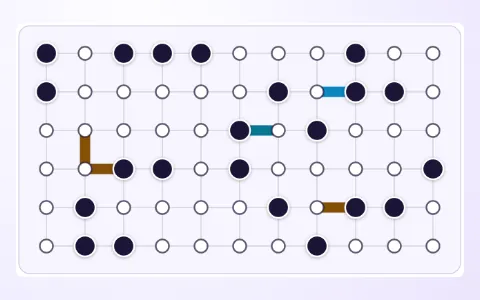
Classic: a solid dot sits in a corner. Its two neighbours are both white, but one of them is boxed in by other endpoints — any path through it would be too short.
So the corner path must leave through the other neighbour. Following forced steps like this, paths grow out from the edges and corners.
Strategies
- Corners and dead ends. A dot with only one free neighbour must connect to it — and an endpoint with one free neighbour must start that way.
- Count to the length. If a path already has five of its six dots, it must finish on the adjacent endpoint.
- Don’t strand dots. Before you draw a step, check it doesn’t cut off a pocket of dots too small (or the wrong size) to make paths.
- Endpoints are walls. A path can never pass through an endpoint, so endpoints split the board into lanes.
- Use the extra rules. Sums, words and turns cut the choices down fast — look for the endpoint with the fewest ways to work.
Common mistakes
- Running a path through an endpoint.
- Making a path the right length but leaving a few dots stranded that no path can reach.
Where it comes from
Path-partition puzzles of this kind have appeared as circuit and connect-the-dots challenges in puzzle magazines. Circuit Paths was made for this site, with a declarative rule engine, an exact-cover solver, a generator and a creator.
Frequently asked questions
Is there always exactly one answer?
Yes — every generated puzzle is checked by the solver. Locked segments (drawn thicker) are added only when needed to make the answer unique.
Can I make my own?
Yes — open the Creator: build a board, set the rules, draw a hidden solution, derive the clues, make it unique and export or share it.
What is Present mode?
It hides the side panels and makes the board as big as possible, for teaching on a projector or big screen.
Keep going
- Play Circuit Pathsa fresh puzzle every time
- Pair PathsJoin each pair of matching numbers with a path across or down; paths never…
- Number PathDraw one path from 1 that passes through every square once, reaching the…
- SlitherlinkJoin the dots into one closed loop so that each number says how many of its…
All guides: How to play every puzzle and game.