any numbers · every row and column · cages make their targets
Play Flexi Cages
00:00
Tap a square, then a number✏️ notes · keys 1–8 · N for notes
How to play Flexi Cages
Flexi Cages takes the classic cage puzzle — fill a grid so every row and column has each number once, and every outlined cage makes its target with its operation — and lets you choose the numbers. The grid can use 1 to N as usual, but also 0 to N−1, multiples of ten, consecutive even or odd numbers, primes, negative numbers, unit fractions like ½ and ⅓, decimals, or letters.
Changing the numbers changes the thinking. With fractions, a + cage of 1⅚ means ½ + ⅓ + 1. With negatives, a + cage can make 0. With letters, the cage x²y tells you it holds two x’s and a y — algebra without any equations. Arithmetic is exact, so fractions stay fractions.
The idea comes from classroom work showing that one cage layout can teach many kinds of number sense — a “low floor, high ceiling” puzzle for every learner. Every puzzle here has exactly one answer and can be solved by reasoning alone.
How to play Flexi Cages
Fill the grid so each row and column uses every number of the set once, and every cage makes its target with its operation.
The rules
The puzzle uses a set of N numbers (for an N×N grid): 1 to N, or another set such as tens, primes, fractions or letters.
Each row and each column contains every number of the set exactly once.
Each cage shows a target and an operation (+, −, × or ÷). Its numbers make the target with that operation, in any order. A number may repeat in a cage if the repeats are in different rows and columns.
− and ÷ cages have two squares: the bigger number minus (or divided by) the smaller. A single-square cage just gives its number. With letters, the cage lists the letters it holds (2x + y = two x’s and one y; x²y = the same with ×).
Playing here
Choose the numbers to use — 1 to N, 0 to N−1, tens, evens, odds, primes, negatives, fractions, decimals or letters — a grid size and a difficulty, then press New Puzzle.
Every row and every column uses each number of the set exactly once.
Each outlined cage shows a target and an operation: its numbers must make the target that way, in any order. − and ÷ cages have two squares (bigger number first). With letters, a cage like 2x + y or x²y says which letters are inside.
Tap a square and pick a number from the pad (or keys 1–8, in the pad’s order). ✏️ adds pencil notes. Hint explains the next square.
Tips
Single squares first. A one-square cage is a free answer.
List the combinations. For each cage, list the sets of numbers that make the target — often only one or two fit.
Use the extremes. The biggest product or sum can only come from the biggest numbers; a difference of (largest − smallest) fixes both ends.
Rows and columns. Once a number is placed, it can’t appear again in its row or column — that often settles a cage.
1 to N, 0 to N−1, tens, consecutive evens, consecutive odds, primes, negatives (centred on 0), unit fractions (1, ½, ⅓…), decimals, and letters x, y, z, w, v, u.
How do the letter cages work?
A cage like 2x + y or x²y tells you which letters are in it and how many of each. Rows and columns still use every letter once.
Is there always one answer?
Yes — every puzzle is checked so that one answer fits, and it can be reached by reasoning.
 Sudokuevery digit once in each row, column and box
 Sudoku Variantsfifteen twists on classic sudoku
 Killer Sudokusudoku with cage sums
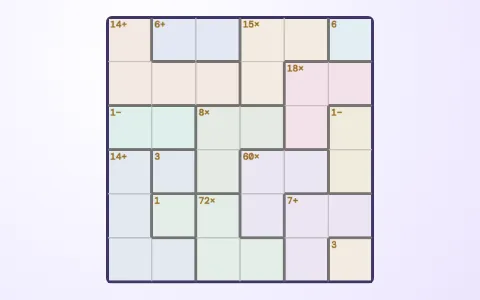 Calcudokucages, targets and + − × ÷
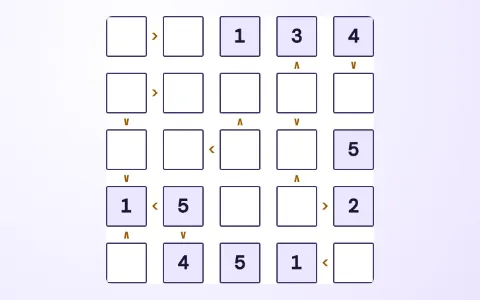 Futoshikia Latin square with < and > signs
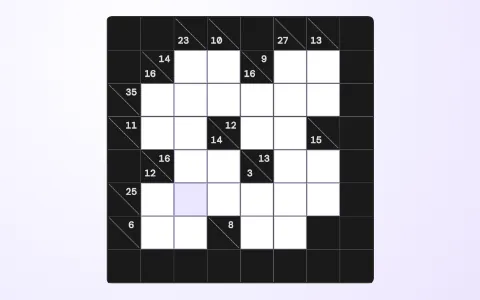 Kakuroa crossword with digits