How to play Flexi Cages
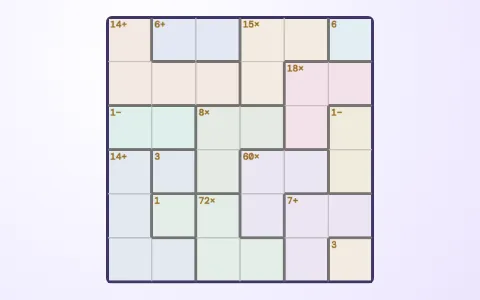
Fill the grid so each row and column uses every number of the set once, and every cage makes its target with its operation. Also known as Cage puzzle with any numbers.
The rules
- The puzzle uses a set of N numbers (for an N×N grid): 1 to N, or another set such as tens, primes, fractions or letters.
- Each row and each column contains every number of the set exactly once.
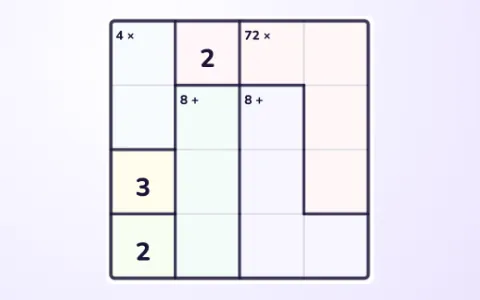
- Each cage shows a target and an operation (+, −, × or ÷). Its numbers make the target with that operation, in any order. A number may repeat in a cage if the repeats are in different rows and columns.
- − and ÷ cages have two squares: the bigger number minus (or divided by) the smaller. A single-square cage just gives its number. With letters, the cage lists the letters it holds (2x + y = two x’s and one y; x²y = the same with ×).
Playing Flexi Cages on Puzzle Solvers
- Choose the numbers to use — 1 to N, 0 to N−1, tens, evens, odds, primes, negatives, fractions, decimals or letters — a grid size and a difficulty, then press New Puzzle.
- Every row and every column uses each number of the set exactly once.
- Each outlined cage shows a target and an operation: its numbers must make the target that way, in any order. − and ÷ cages have two squares (bigger number first). With letters, a cage like 2x + y or x²y says which letters are inside.
- Tap a square and pick a number from the pad (or keys 1–8, in the pad’s order). ✏️ adds pencil notes. Hint explains the next square.
A worked example
Numbers ½, ⅓ and 1 on a 3×3 grid. A two-square cage says ⅙ ×: only ½ × ⅓ makes ⅙, so those two squares hold ½ and ⅓ in some order.
If the column of the first square already has a ⅓, it must be ½ — and the other square is ⅓.
Strategies
- Single squares first. A one-square cage is a free answer.
- List the combinations. For each cage, list the sets of numbers that make the target — often only one or two fit.
- Use the extremes. The biggest product or sum can only come from the biggest numbers; a difference of (largest − smallest) fixes both ends.
- Rows and columns. Once a number is placed, it can’t appear again in its row or column — that often settles a cage.
- Think about the set. With fractions, sums with sixths need ½ and ⅓; with negatives, a product sign tells you how many negatives are inside; with letters, just count them.
Common mistakes
- Forgetting that − and ÷ take the bigger number first.
- Repeating a number in a cage when both copies are in the same row or column.
Where it comes from
Cage puzzles with arithmetic targets became popular worldwide in the 2000s. Using other number sets — fractions, integers, letters — is a classroom idea from mathematics educators, who showed one cage layout can practise many kinds of number. Flexi Cages was made for this site.
Frequently asked questions
Which number sets are there?
1 to N, 0 to N−1, tens, consecutive evens, consecutive odds, primes, negatives (centred on 0), unit fractions (1, ½, ⅓…), decimals, and letters x, y, z, w, v, u.
How do the letter cages work?
A cage like 2x + y or x²y tells you which letters are in it and how many of each. Rows and columns still use every letter once.
Is there always one answer?
Yes — every puzzle is checked so that one answer fits, and it can be reached by reasoning.
Keep going
- Play Flexi Cagesa fresh puzzle every time
- Dot SudokuA sudoku where white dots join consecutive numbers, black dots join a number…
- Sudoku VariantsClassic sudoku — every row, column and box holds each digit once — plus one…
- Times GridA multiplication square with the headers and most products hidden — divide to…
All guides: How to play every puzzle and game.